
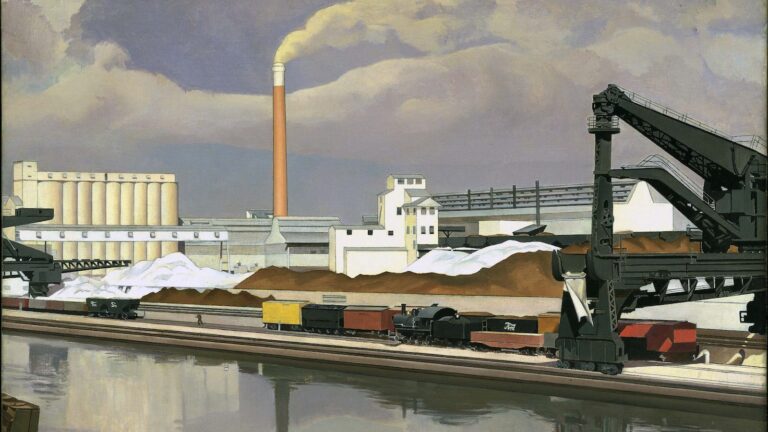
For generations, Detroiters have celebrated the Fisher Building as “the city’s largest art object,” a masterpiece of ornament, color and civic aspiration – and rightly so. Yet the work of Charles Sheeler and Michael Kenna reminds us that Albert Kahn’s industrial architecture possesses an equally profound, if less expected, aesthetic power. The prime example of that power is the colossal Ford River Rouge Complex.
Sheeler’s 1927 commission at the Rouge revealed an artist captivated not by decoration, but by the clarity of form, the orchestration of mass and the almost musical precision of Kahn’s integrated factory. His photographs and later paintings distilled the site into a pure geometry of stacks, conveyors, silos and slipways arranged with a compositional rigor that bordered on the sublime. In Sheeler’s hands, the Rouge became a new kind of American landscape that was idyllic in its stillness, monumental in its scale and abstract in its beauty.
Decades later, Michael Kenna returned to the same ground and found a different, more atmospheric poetry. Through long exposures, drifting steam and the quiet of partial abandonment, Kenna revealed the Rouge as both powerful and fragile, a place where industry and time coexisted in tension.
Together, Sheeler and Kenna demonstrate that Kahn’s industrial works are not only amazing feats of engineering and scale, but they are also enduring sources of artistic imagination, capable of inspiring awe far beyond their original purpose.
Read ArtDaily’s illustrated narrative about the remarkable works produced by Sheeler and Kenna at the Ford River Rouge Complex.