

By John Gallagher – For the Albert Kahn Legacy Foundation.
Albert Kahn was still a young man when he designed Detroit’s historic Packard Plant at the dawn of the 20th century.
The sprawling industrial site that emerged from Kahn’s drawing table did more than establish Kahn as an architect of reckoning in one of the nation’s fastest growing cities. It also helped launch Detroit as the Motor City to the world.
With announcements that a new team has been chosen to redevelop the old Packard complex, the site that Kahn created can once again demonstrate Detroit’s powers of renewal and reinvention.
Known as Packard Park, the planned project announced in December is a “public-private-philanthropic partnership” that taps into the knowledge of the Albert Kahn Legacy Foundation, as well as the firm Kahn founded as the project’s architect.
As then Mayor Mike Duggan told the media during the project unveiling in early December, “They are going to take a historic site and create a destination right here on Grand Boulevard.”
And incoming Mayor Mary Sheffield echoed that: “For decades, as the mayor mentioned, the Packard Plant stood as one of the city’s most visible reminders of disinvestment and decline. But today, we declare, collectively, that those days are over.”
No official price tag has been released but Bennett said in the interview that the final price is likely to be upwards of $50 million. It’s likely to be much higher: Bennett suggested the new manufacturing building could cost $150 per square foot to build, translating to about $60 million for that element, plus the extensive reimagining of the existing Kahn-designed building.
Bennett said the project, already about two years into planning, should start construction in about a year with an opening around 2029.

The Packard Site Legacy: Rise and Fall
Kahn’s initial design consisted of about 40 buildings sprawling across as many acres along East Grand Boulevard on Detroit’s east side. The manufacturing hub eventually grew to twice as many structures, churning out tens of thousands of luxurious Packard automobiles into the mid-1950s.
But as Detroit architectural historian Dan Austin has written on his historicdetroit.org website, the once illustrious Packard company “ran into trouble when it bought the Studebaker Corp. in 1954. The merged company never turned a profit. The Detroit plant closed when the last true Packard was produced in 1956. The name itself was discontinued two years later.”
And for the next 75 years the slowly rotting Packard Plant site came to symbolize the downfall of a once great city. Photographic vultures looking for “ruin porn” flocked to the Packard Plant; illegal music parties known as raves gave the site a certain underground notoriety. The stripped and crumbling structures had become what former Detroit Mayor Mike Duggan once called “a source of national embarrassment.”
After false starts with several other development teams, the city razed most of the remaining Packard buildings in recent years, leaving two of Kahn’s buildings in place facing each other across East Grand Boulevard. Those two buildings are now central to the latest proposal.
Vision for Packard Park Includes Residential, Recreational, Cultural and Business Elements
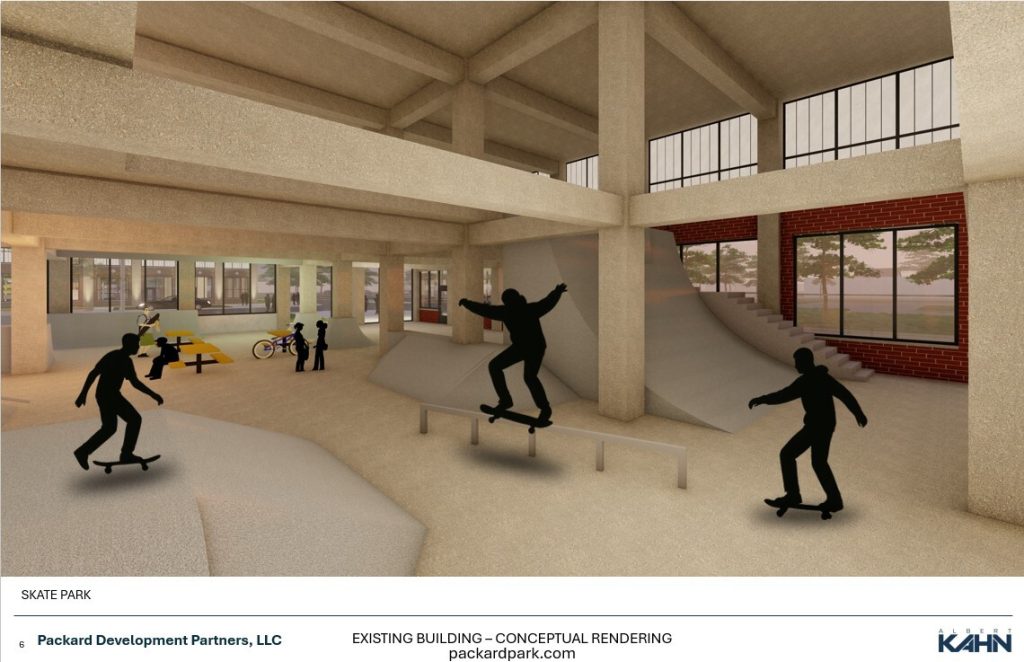
The central plan calls for adapting the old Packard building on the south side of Grand Boulevard as a cultural center and indoor skate park with affordable housing units above. In addition, the plan details the construction of a nearly 400,000-square-foot manufacturing building running to the south, which will be suitable for about 300 jobs.
Plans also call for creation of the MODEM or Museum of Detroit Electronic Music, which is a cultural nod to the globally renowned, underground rave events which occurred at the site for years and the city’s well-earned reputation as the birthplace of techno music. The Packard Park master plan also details the creation of more than two acres of public space and recreation areas.
If all works out, Bennett said in an interview for this story, the remaining Packard building north of Grand will be renovated in similar fashion and another new manufacturing building to be constructed running to the north.
No cost has been released for the 42 units of what is described as live/work housing on the two upper floors of the Kahn-designed building although the project aims at making them “affordable,” which generally means available to households making some percentage of the area median income. Bennett said the housing will be aimed at artists and crafts makers, part of making Packard Park a vibrant cultural center as well as a manufacturing hub.
To date, no industrial occupant signed up for the new manufacturing building, but the project has retained Signature Associates to broker potential industrial tenants. The building will be built to suit once an occupant is identified.
The Packard Park Redevelopment Dream Team
Developers Oren Goldenberg and Mark Bennett bring different experience and skills to the project. Goldenberg most recently rehabbed a former Lincoln plant into the mixed-use Dreamtroit project near the Henry Ford Hospital complex. Bennett has developed various real estate projects in Detroit.
The development team also includes Detroit-based Resurget Engineering; Plymouth-based engineering firm SME; PEA Group; Plante Moran; Invest Detroit; the Honigman and Miller Canfield law firms; and others. Financing is coming from Nuveen Green Capital, SB Friedman and BWE. The Detroit Economic Growth Corp. is also involved.
The Albert Kahn Legacy Foundation is also working closely with the Packard Park developers as the philanthropic fiduciary on the project. The Foundation is also involved as a fiduciary and architectural consultant in overseeing multiple restoration efforts at the Fisher Building.
New Vision for Packard Site Emblematic of City’s Focus on Historic Preservation and Adaptive Reuse
As Goldenberg notes, the Packard Plant may be Detroit’s “last legacy site,” the final truly historic location still awaiting new use after the Michigan Central Station reopened in glorious fashion in 2024 and the once-derelict Book-Cadillac Hotel reopened as a modern Westin property in 2008. Other sites have likewise been transformed in recent years as Detroit finally shrugged off more than a half-century of decline to start growing again.
For a young Albert Kahn, the sprawling Packard Plant became the first of his numerous monumental industrial designs that later included Henry Ford’s Highland Park site and the historic Rouge Plant in Dearborn. Both of those sites redefined how American factories were built.
Indeed, Kahn’s Packard Plant experience may have been in his mind when Ford asked him if he could design factories for his growing car company. Kahn replied, “Mr. Ford, I can design anything!”
Indeed, he could.
# # #
John Gallagher is a veteran journalist and author who covered the development and architecture scene in Detroit for 32 years as a reporter and columnist for the Detroit Free Press. He also authored multiple books, including Yamasaki in Detroit: A Search for Serenity and Rust Belt Reporter: A Memoir. Retiring from the Free Press in 2019, John continues to freelance, speak publicly, and work on book projects


