

As told by Nancy Finegood, granddaughter of the immigrant family
Prior to World War II my grandparents, Arthur and Piroska Tennenbaum, and their daughter, Ilonka (Helen) lived a pleasant life in Zurich, Switzerland. Arthur had graduated in 1911 from ETH University in Zurich (where Albert Einstein also studied) with a degree in Civil Engineering and had gone on to become a highly successful engineer with the construction company Heinrich Hatt-Haller AG. Piroska devoted her time to their daughter and their home.
The Tennenbaums were Jewish, and in 1940, as World War II raged in Europe, Arthur became concerned for the safety of his family. Though Switzerland was a neutral country, the Nazis spread word that Hitler planned to invade Switzerland. In 1941, my great uncle, Richard (my grandfather’s brother), who traveled to the US on business quite often, convinced Arthur and Piroska to leave their home and find a way to immigrate to the United States. (After the war it was determined that Hitler did have plans to incorporate the German-speaking regions of Switzerland—70% of the country—into Germany.)
Years later my mother described her escape from Europe in her journal.
“I was not yet 8 years old [in 1941], when my parents told me that we would be taking a trip from our home in Zurich to a small chalet in the French part of Switzerland. My father settled us in a tiny wood cabin on the property of Swiss peasants a safe distance from the Nazis approaching the borders. Bombs began dropping across the border in France, so my father returned from his duty in the Swiss army to take us back to Zurich. Soon after, the family boarded a train to Spain, a terrible trip where we ran out of food and then water. We then traveled to Portugal where we felt some semblance of security and safety. Twice we were scheduled to fly from Portugal to New York City on the Pan Am Yankee Clipper, but lost our seats to ‘important officials.’ Our transit visa in Portugal was running out when we received a phone call telling us to get to the airport as three seats had become available. Finally, we flew to the Azores and then to Bermuda, before landing in New York City.”
In order to immigrate to the US after 1940, my grandparents were required to find two American financial sponsors. Those sponsors, most often relatives, had to collect and send documents promising to take financial responsibility for the immigrants after they arrived in the United States. One sponsor was the well-known Jewish architect, Albert Kahn. My grandfather’s employer in Switzerland knew Kahn and asked him to sponsor my grandparents and give Arthur a job at his architectural firm. Kahn agreed and Arthur, Piroska, and Helen traveled to Detroit, where they knew no one, but felt that they would be safe.

When they arrived by train in Detroit in 1942, their trunk was sent directly to the Book Cadillac Hotel, where Albert Kahn had made arrangements for them to stay until they found a permanent home. Albert Kahn passed away in December 1942, just months after my family arrived.

During the 8 months that my grandfather worked for Kahn, the family moved two more times, finally moving to the upstairs of a two family flat on Tyler Street where they lived for many years. In April 1943, when my grandfather left Kahn, he went to work for the architectural firm of Giffels & Rossetti, which was engaged in vital war work at the time. After the war Arthur was involved with the design of Cobo Hall, of which he was most proud.
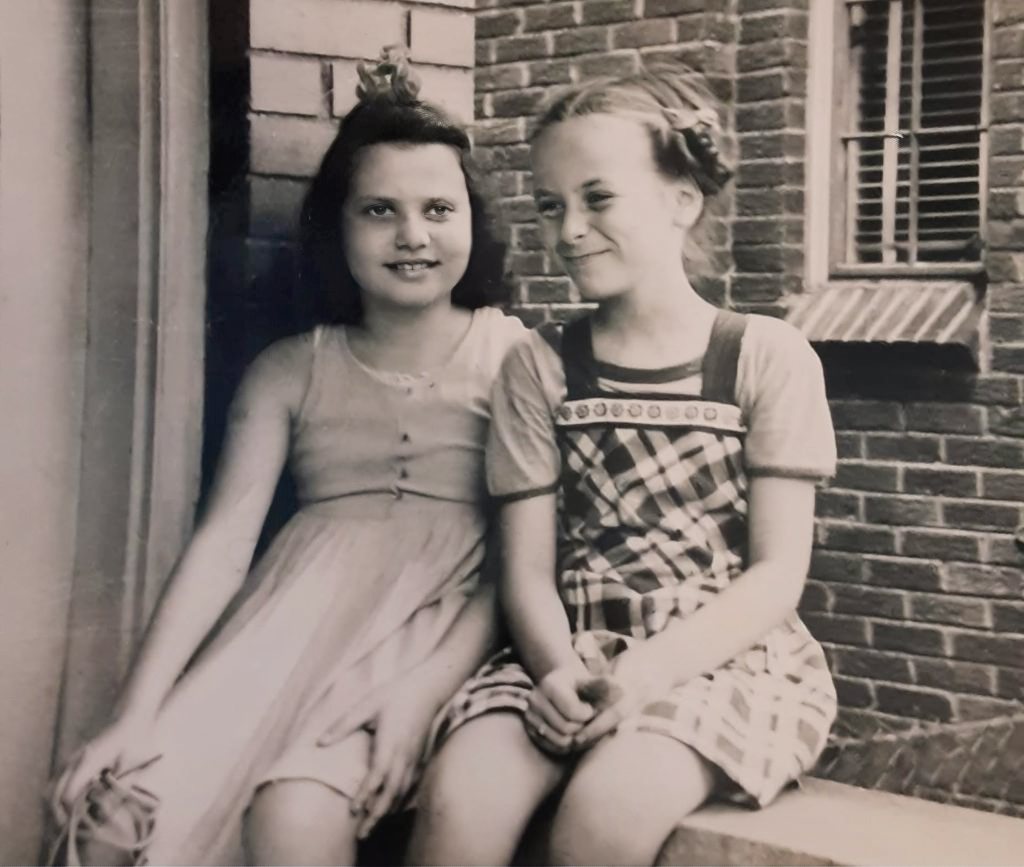
Arthur and Piroska spoke German at home, but were adamant that my mother learn English as quickly as possible, so that she could assimilate. They legally changed their last name to Teneen, so it wouldn’t be so foreign sounding, though they later changed their name back to Tennenbaum.
Helen went to Central High School, where she was well liked and became editor of the school newspaper. She had a column, “Teen-Age Sophisticates,” in The Detroit Jewish Chronicle from 1947 to 1951.
Shortly after graduation from High School, my grandparents took Helen on vacation to a popular Jewish resort in South Haven. There she met Alfred Spiegel, a handsome and shy young man from Chicago. Alfred was born in Europe and was a child survivor of the Holocaust. Helen and Alfred soon married and had two children, my brother, born in 1951, and myself in 1953.
It was very difficult for my grandparents to leave their beloved Switzerland during WWII. They did return to visit, via ship, several times and are in fact both buried with several generations in the old Jewish cemetery in Zurich.
I’m grateful that Kahn’s sponsorship made it possible for Arthur, Piroska, and my mother, Helen, to build a successful new life in Detroit.
What a wonderful story!
What a heart warming family story
Thank you for sharing.
Nancy
Thank you for sharing your incredible family story and sharing the Albert Kahn Legacy Foundation. I hope to get back up to Michigan soon. Seeing Albert Kahn buildings and people like you who work to preserve them is a joy!
What a wonderful story. I’d like to share this with another friend. May I have your permission?
Yes, of course!